5
Axes for Mould & Die
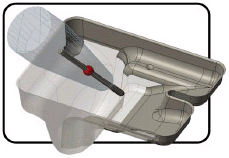
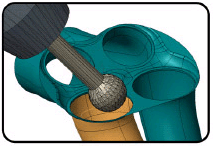
Many complex moulds contain deep cavity
areas and small radii which need to be machined
with small diameter tools. Normally this
would involve the use of tool extensions
or longer tools which would increase the
risk of deflection and provide a poor surface
finish. By approaching this from a different
angle, it allows for the use of shorter
tools to increase rigidity and maintain
a consistent and quality surface finish.
This approach also benefits from shorter
tool movements, reduced programming and
cutting time plus fewer machine set-ups.
AUTO-Series creates true HSM strategies
within its 5 axis toolpaths for mould and
die and can work on either Solid, Surface
or STL models. The mould and die application
supports multiple tools shapes including
Ball nose, Tapered ballnose and ‘lollipop’
style cutters.
5 Axes for
Aerospace
Today’s aerospace companies are driving
towards improved aircraft efficiency and,
whilst much of this is being provided by
the latest series of fuel efficient engines,
reduction in aircraft weight is also proving
invaluable.
AUTO-Series provides a dedicated and powerful
feature set for the machining of all Aerospace
type requirements including turbine blades
and aero structures.
Single set-up, enhanced surface finish,
increased reliability, multiple tool type
support and advanced collision avoidance
are just a few of the many benefits available
to aerospace manufacturing companies.
5 Axes for
Automotive
5 axis machining in the Automotive industry
covers many areas from plastic trim and
drive train to engine components and turbo
impellers.AUTO-Series caters for the complete
spectrum of machining requirements for automotive
manufacturers.
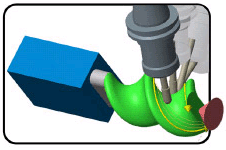
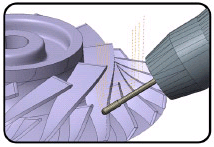
Machining of turbo impellers is probably
the most recognised of 5 axis machining
requirements and this is primarily due to
the advanced collision control that is required.
By using the ‘swarf cutting’ options within
AUTO-Series optimum machining of impellers
is a simplified process. Other specialist
areas of manufacture include the machining
of engine inlet and exhaust ports.
Many manufacturers are developing reduced
emission engines and it is imperative that
these areas are optimised to provide better
performance with reduced fuel consumption.
The dedicated port machining routine included
within AUTO-Series ensures that these optimum
levels can be achieved.
Advanced
Solutions
4 axis and mill/turn routines cater for
the needs of cutting tool manufacturers,
engine component suppliers who require single
set up milling and turning operations on
parts such as cam shafts and manufacturers
of items such as extrusion screws.
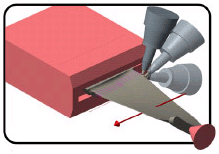
Trimming of vacuum formed or GRP/Carbon
fibre moulded components can be achieved
with ease. Swarf cutting routines trim the
desired shape using the side of the cutter.
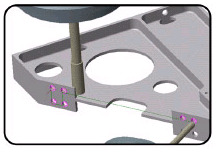
Laser cutting benefits from the ability
to create mutli axis trimming toolpaths
for the machining of thin sheet material
such as die formed metal components and
the ability to machine those areas which
are difficult to reach with traditional
machining techniques. Laser cutting is ideal
for pre production runs where metal stampings
require trimming or when single set up trimming
is required for production speed.
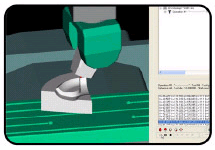
Machine simulation is an important part
of mutli axis machining and the AUTO-Series
application includes an advanced machine
tool definition routine which allows for
the complete creation of the machine tool
including axis configurations, machine limits,
etc. The operator can then simulate the
machining process and, at any time during
the simulation, can manipulate the image
to provide closer representations or rotations
around the machine to view from different
angles.
All the AUTO-Series applications include translators for IGES, DXF, DWG,
Parasolid, STL and VDA as standard with
optional interfaces for Catia V4, V5 and
Catia 2D, Unigraphics, Pro/E, ACIS and STEP.
Large files can be handled with ease and,
with the benefit of AUTO-Modelling, 3D and
2D CAM plus 4 axis Wire EDM the user can
ensure total machining ability within one
simple to use interface.
AUTO-Series also includes dedicated applications
for mould tool design, component splitting
and analysis, progressive die design, press
tool design and analysis and high end 3D
machining.
|